
🌀 The Joy Line
How joy became possible—even when life didn’t get easier.

For a long time, I believed joy came after.
After things got easier.
After I solved the problem.
After I became the version of myself I thought I should be.
I used to say things like,
“If only I had more money.”
“If only Eric were more romantic.”
“If only I weighed less.”
“If only life felt easier.”
And because none of those things were true, I postponed joy.
I put it on layaway. Deferred it. Told myself it would come later—once I finally arrived in the right life.
What I didn’t see then was that I was living in a state of lack.
I obsessed over the house my neighbor had just renovated. Seethed about the new pool they were installing. Watched colleagues go on vacations I couldn’t afford and felt shame wash over me like a wave I didn’t know how to name.
It wasn’t just envy. It was a deep, aching belief that joy belonged to someone else. That I had missed the boat.
At the time, I didn’t have language for emotional regulation or self-compassion. I was just trying to hold everything together. I didn’t know there were tools that could help shift my relationship to life—or that joy was one of them.
But over time, I began assembling and building those tools. Slowly. Messily. In the cracks of daily life.
I didn’t have a roadmap—but I did have a grounded spiritual teacher. She kept pointing me inward, even when I didn’t want to look. I remember being furious with her at first—because I wanted someone else to be the problem. But over time, her quiet wisdom helped me see: real change starts within.
That’s when things began to shift.
You can actually change your emotional set point.
Not overnight. But gradually. Intentionally. With practice.
I no longer live in a constant state of fear, resentment, or self-blame.
I still dip into those places - of course I do - but I know how to find my way back.
I’ve learned what supports me. I’ve developed ways to interrupt the spiral.
I know how to return to a grounded, honest center.
And that has changed everything.
At some point, I drew a sketch to help make sense of what I’d been learning.
A visual reminder that joy wasn’t something I achieved by fixing my life—
It was something that began to rise alongside the mess.
I called it The Joy Line.
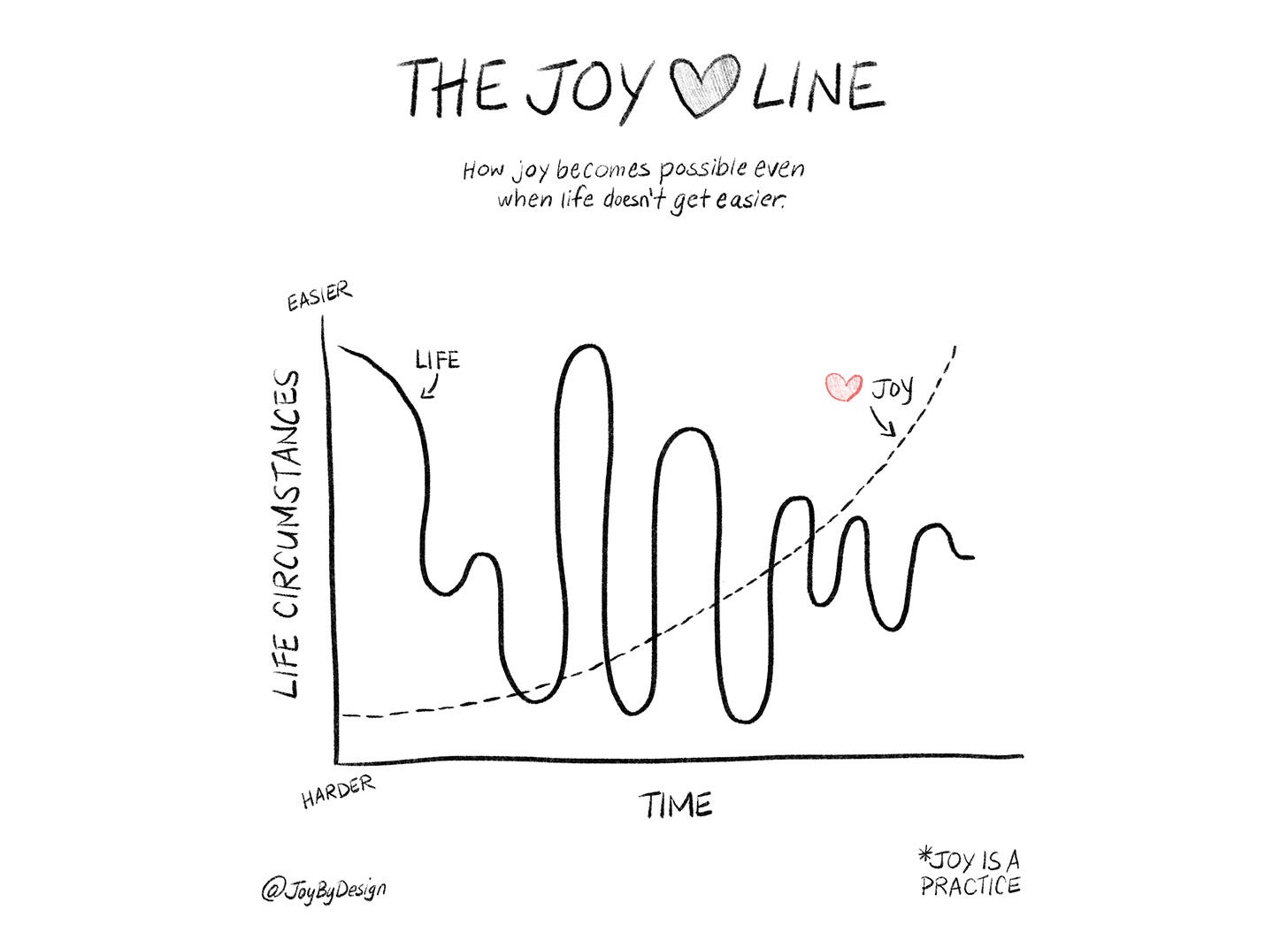
The black line is life—moving up and down, as life does.
The dotted line is joy. Not happiness, necessarily. Not lightness or ease.
But joy as a kind of resilient optimism. A steadiness. A foundation.
It’s the emotional grounding that made it possible to stay in my life, even when it was hard.
But here’s the part no one tells you:
When I finally began to live with more intention—when I stopped waiting for joy and started practicing it—my life got harder.
It was almost as if the universe said, “Great. You’re ready. Let’s practice.”
In the last two years alone, our family has faced some of our most painful moments.
Including something I haven’t shared publicly until now:
After 26 years of marriage, I left Eric.
Not in anger. Not in desperation. But in clarity.
I had stopped blaming him for what I lacked. I had worked—truly worked—on my own internal compass. I had learned to live with presence and compassion. And I left not because I was bitter, but because I was finally whole enough to do it with love.
And something remarkable happened.
That’s when Eric began to change.
He started doing his own inner work. Not to win me back—but to become more whole.
That moment of separation—painful and honest—became the starting point for his Joy Line.
We didn’t know we’d find our way back.
But we did.
And what we’ve rebuilt is more connected, more honest, and more alive than anything we had before.
Now, we’re writing this together.
Joy isn’t just about doing.
It’s not just yoga or journaling or creative time—though those things help.
Joy is a way of being.
It’s a moment-by-moment posture of curiosity.
A practice of emotional spaciousness.
A shift in how we meet our lives—especially the hard parts.
Over the past 15 years, I’ve collected tools that support this practice—and even built a few of my own.
(One of my favorites is called the Energy Gauge, and I’ll be sharing more about that soon.)
But for now, I just wanted to share this:
You don’t have to wait.
You don’t have to earn joy.
You can build it now—imperfectly, honestly, and on purpose.
Let me know if this post resonates with you—or if you’ve ever tried shifting your own emotional set point. I’d love to hear what it looks like for you.
Thanks for reading Joy by Design ! Subscribe for free to receive new posts and support our work. We’d love to have you in our community!